
Back to Basketball After ACLR
Published - Sep 09, 2026
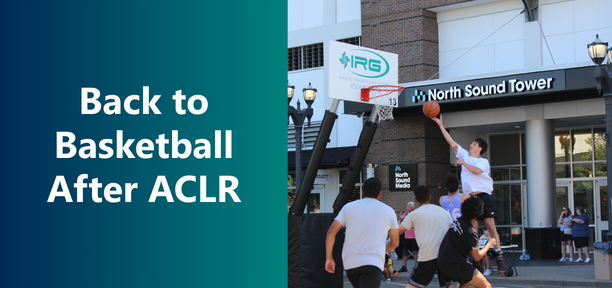
Getting Back into the Gym after ACLR: Basketball Edition
Coming back from ACL reconstruction is a long road, and for basketball players, one of the hardest parts isn't the swelling or long blocks of strength training — it's figuring out when it's actually okay to touch a ball again in a way that feels like actual skill work.
Athletes want to feel useful and see progress, and parents want reassurance that their child is moving forward, not standing still. But "getting back in the gym" doesn't mean all at once, and it doesn't mean skipping straight to drills that look like game action. This post walks through why that is, and how skill work can still have a place in rehab when it's introduced the right way, at the right time. It's up to the athlete and the primary rehab provider to work together to come up with safe guardrails throughout the process.
Save the Ball Handling for the Court: Why Basketball Skill Work Belongs in the Gym You Play In (Not Just the One You Rehab In)
If you've torn your ACL, you already know the drill: months of rebuilding your workload capacity, strength, power, and confidence. Somewhere in that timeline, a lot of athletes (and parents) start asking a reasonable question: can I at least start working on my handles or my shot in the meantime?
Too often, we hear from athletes that they haven't been given the green light to reintegrate back into the court. This is absolutely NO fault of their own!
It is up to the rehab staff to make sure we communicate to the athlete that they should be integrating back into skill work as soon as possible, in a safe and graded manner of course.
Why the PT Clinic Isn't the Same as the Court
There's a well-established idea in motor learning research called specificity of practice. The short version: a skill you build in one environment doesn't automatically transfer to a different environment, especially when the two environments demand different things from your eyes, your decision-making, and your body all at once.
Dribbling a ball in a hallway, doing cone drills in a physical therapy clinic, or shooting free throws in your driveway is not the same task as playing basketball. Basketball is unpredictable. You're reading a defender, reacting to a teammate's cut, deciding in a split second whether to plant, pivot, or explode past someone — all while your knee is absorbing forces you can't script ahead of time. Researchers describe this as a constant loop of seeing, deciding, and moving that's tightly coupled to the real environment the sport happens in.
That's exactly why doing "basketball-looking" drills in a controlled setting can be misleading. Your body might look ready. It's dribbling, it's cutting, it's shooting. But none of that has been tested against the chaos of an actual defender closing out, getting your shot off from different angles in the gym, a rebound bouncing unpredictably, or the need to decelerate hard and change direction without warning. The nervous system needs to relearn skill in the context it will actually be used in — and during ACL rehab, it's tough enough to regain your capacity to do things on the court (strength, explosive strength, cutting/change of direction ability) without having to waste precious hours in the PT clinic doing low level basketball drills when you'd be better off using that time for what we do best, restore your physical capacity!
Practicing pretty-looking skill work in a sterile room can create false confidence — for the athlete and for whoever's watching from the sideline.
When Randomness Gets Mistaken for Specificity
Here's where a lot of well-intentioned programs go sideways. Once the "no unpredictability" phase is over, the instinct is to add chaos back in fast — a reaction light, a random verbal cue, a partner calling out numbers to trigger a cut. It looks sport-specific. It's unpredictable, it's reactive, it demands a fast decision. Case closed, right?
Not quite. Random reactive drills are not automatically representative of sport, because randomness and specificity aren't the same thing. A light flashing on a wall or a coach yelling "left!" gives an athlete a signal to react to — but it strips out the actual information a basketball player reads on the court: a defender's hip angle, a teammate's shoulder lean, the flight of the ball, the spacing of four other bodies. Reacting to a random cue trains reaction speed. Reacting to a defender's real movement trains basketball. Those are not interchangeable, and treating them as if they are can leave a gap in rehab that doesn't show up until an athlete is back in a live game.
Individual → Environment → Task: A Better Lens for Judging Specificity
A more useful way to think about whether a drill is actually preparing an athlete for sport is to look at three things at once, and how they interact:
- The individual — this athlete's body, their movement history, their current capacity, where their knee actually is in recovery.
- The environment — the court, the defender, the teammates, the rim, the game situation the athlete is standing in.
- The task — the actual goal in that moment: score, keep possession, close out, box out, protect the ball.
Skill work only crosses over to sport when it asks the athlete to solve a real problem that the environment is creating for a real task, using their own capacities — not when it simply looks busy or reactive. A crossover dribble in isolation is a movement pattern. A crossover dribble used to beat a live defender who is actually taking away your driving lane is a solved problem. Those look almost identical on video and are worlds apart in terms of what they're actually training.
That's also why intent matters. Movement needs to be purposeful — solving a live problem the environment created — not just a rehearsed pattern performed on cue. For a coordinative task (a cut, a closeout, a dribble move) to genuinely transfer to competition, the drill needs to recreate all three of those demands together: the athlete's capacity is being tested, the environment is presenting a real constraint (a defender, tight space, limited time), and the task goal is driving the decision. Take any one of those three out, and you're training a skill in isolation — which has value early on, but shouldn't be mistaken for game readiness.
When the Rehab Team Meets the Skill Development Team
None of this works well as a solo effort. The rehab side (PT, athletic trainer, surgeon) and the skill development side (skills coach, strength coach, sport coach) are answering different questions, and both matter: rehab is asking "what can this knee safely tolerate right now?" Skill development is asking "how do we build basketball-specific competence within that?" The handoff between the two is where good return-to-sport planning actually happens.
In a professional setting, this tends to be fairly structured. The rehab team clears specific movement qualities and capacities — deceleration control, single-leg landing tolerance, hop test symmetry, tolerance to change of direction at a given speed — and hands the skill development staff a clear set of constraints to work within. Something like: "cleared for full-speed linear deceleration, not yet cleared for reactive lateral cutting" or "cleared for controlled 1v0 closeouts, no live contact yet." The skill development coach then designs the actual basketball work inside those boundaries, and the two groups stay in a tight communication loop as capacity keeps changing week to week.
In a more likely youth or adolescent setting, that structure often doesn't exist in the same way. There may not be a dedicated skill development coach at all. If you're a Fremont area high school player at surrounding schools like Lincoln High School, Ballard High School, Bishop Blanchet, or Roosevelt High School, it may be up to the rehab provider and individual athlete to build trust and decide on setting up restrictions for the athlete to go explore skill work on the court on their own. In that setting, the responsibility to build in guardrails often falls more on the rehab team communicating directly and clearly with the athlete, and sometimes the family and coaches too. That means being explicit about what's actually allowed on the court right now, why, and what has to happen before the next boundary opens up. Trust matters here — an athlete who feels like the rules are arbitrary or constantly shifting is far more likely to quietly push past them on their own. An athlete who understands the plan, and who can see the boundaries loosen in a predictable way as their capacity improves, is far more likely to stay bought in for the whole process.
Concretely, this can look like: naming exactly what's cleared this week (stationary ballhandling, straight-line jogging with the ball), naming what's not yet cleared and why (live 1v1, reactive cutting), and setting a clear, visible checkpoint for when the next boundary is expected to open — tied to a test or milestone, not a guess.
Sequencing Skill Work: Guardrails That Loosen Over Time
This isn't an argument for parking the basketball in the closet for nine months. It's an argument for sequencing skill work with guardrails that match where you actually are in recovery, and for gradually stacking demands rather than adding them all at once.
Early on, in the phases focused on rebuilding strength, range of motion, and basic movement control, skill work should stay simple and closed — meaning no unpredictability, no defenders, no live decision-making. Think stationary ballhandling, form shooting, and controlled footwork patterns where every variable is known in advance. This is about reintroducing coordination and confidence with the ball, not simulating basketball.
As rehab progresses and strength, hop testing, and movement quality improve, guardrails can start to loosen — but carefully, and usually only once a physical therapist or athletic trainer has cleared specific movement patterns:
- Add predictable movement before adding chaos. Dribbling while jogging in a straight line comes before dribbling while cutting.
- Add a plan before adding a decision. Practicing a pre-planned cut or crossover comes before reacting to a live defender.
- Add a partner before adding pressure. A coach lightly tossing rebounds comes before boxing out a live opponent.
- Add speed last. Game speed and full-contact, reactive situations are the final stage, not an early one — and typically shouldn't happen until cleared for return-to-sport testing.
This is where the "guardrails" idea matters most: the skill work is real, but the environment is being controlled on purpose, one variable at a time, until the court itself is the safest place to test the last piece.
How We Guide You Through It
If any of this feels overwhelming, that's normal — most people in your position have never had to make these decisions before, and the information out there is scattered and sometimes contradictory. Here's how we simplify it into a plan:
- Initial assessment. We find out exactly where you are in the process right now — strength, mobility, movement quality, symmetry — so the plan is built on real data, not guesswork.
- A personalized plan, whether that's rehab-focused, performance-focused, or both, sequenced through the stages above so skill work opens up as fast as your body is actually ready for it.
- Ongoing coaching all the way through, adjusting the plan as your capacity improves, until you're back to full performance.
The goal isn't just clearing you for basketball. It's making sure that when you're cleared, your body actually trusts itself under game conditions — so you get back to the sport, the job, and the life you had before, or better. The alternative — rushing it, guessing, or letting a plateau turn into giving up on the goal entirely — is exactly what this process is built to avoid: chronic pain, re-injury, and stalled progress that never quite resolves.
Book a free Discovery Call or check out our website to schedule and let's build the plan that gets you there.
The IRG Sports Institute's staff includes the blend you need to return to sport with:
Our Physical Therapy and Performance staff is made up of :
- Orthopedic Certified Specialists (OCS)
- Certified Strength and Conditioning Specialists (CSCS)
- Certified Performance and Sports Scientists (CPSS)
Resources:
Grindem, Snyder-Mackler, Moksnes, Engebretsen, Risberg — "Simple decision rules can reduce reinjury risk by 84% after ACL reconstruction: the Delaware-Oslo ACL cohort study" (Br J Sports Med, 2016) — a landmark study showing criterion-based (not time-based) return-to-sport clearance dramatically cuts reinjury.
Bruce Abernethy et al. — "Effective practice and instruction: A skill acquisition framework for excellence" (2023, Journal of Sports Sciences) — reviews why practice similarity to competition drives transfer, and covers representative task design.